
The Tragedy of the "Good Enough" Marriage
Jun 17, 2026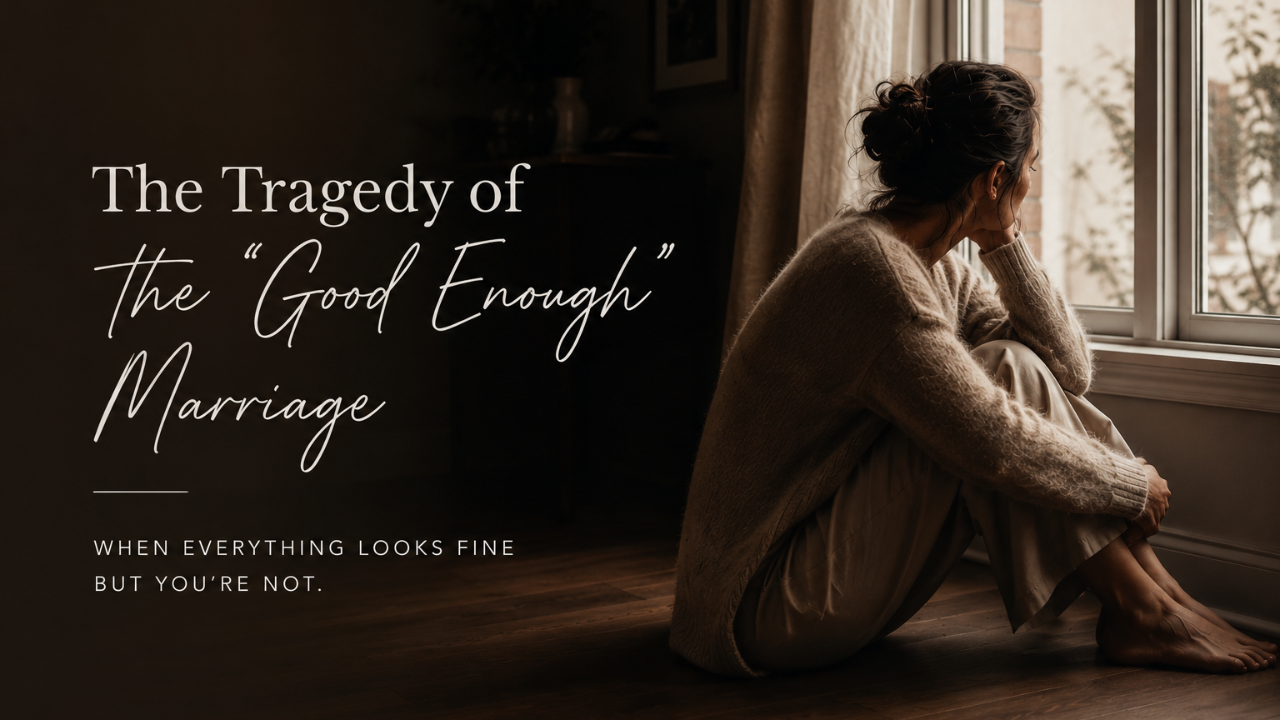
Nobody prepares you for the marriage that isn't bad enough to leave.
We hear stories about affairs. Abuse. Addiction. Betrayal.
Those stories make sense.
People understand why those women leave.
But what about the marriage where your partner is a good man?
The marriage where your friends tell you how lucky you are.
The marriage where your family says, "Every relationship takes work."
The marriage where your therapist encourages you to communicate better, be clearer about your needs, and give it a little more time.
What if, from the outside, everything looks fine?
What if the only thing that's quietly disappearing is you?
One woman I worked with once told me something I have never forgotten.
When I asked her what the hardest part of the whole journey had been, she didn't talk about the divorce.
She didn't talk about moving out.
She didn't even talk about telling her husband.
She simply said,
"The heaviest part was realizing what I'd accepted."
That sentence stayed with me.
Because she wasn't talking about accepting cruelty.
She wasn't talking about accepting abuse.
She was talking about accepting a version of herself that had slowly become normal.
A woman who carried the relationship.
A woman who adapted first.
A woman who understood, forgave, explained, softened, and made herself smaller whenever life asked for another compromise.
Not because anyone forced her to.
Because somewhere along the way, she believed that's what love looked like.
She had become so good at keeping the relationship alive that she didn't notice what it was costing her.
And that's the tragedy of the "good enough" marriage.
It doesn't ask you to betray yourself all at once.
It asks for tiny pieces.
A little less honesty.
A little less desire.
A little less truth.
A little less of who you really are.
Until one day you wake up and realize you don't know where you went.
The heartbreaking part of her story wasn't that her husband was a bad man.
He wasn't.
She spoke about him with kindness.
She knew he cared about her.
She even believed he might have changed in some ways if she'd stayed.
But during our work together, she realized something that was impossible to unsee.
She said,
"The person I am now—or the person I've been craving to become for so long—just doesn't match with the person I've been with."
Read that again.
She didn't say,
"He's the wrong person."
She said,
"I'm no longer the woman who can live this way."
There is a difference.
For so many women, the question isn't,
"Is he a good man?"
It's,
"Who do I have to become in order to stay?"
Because those are two very different questions.
Sometimes a relationship survives because one person keeps adapting.
She becomes the emotional adult.
She manages the difficult conversations.
She notices everyone's needs before her own.
She keeps the peace.
She carries the emotional labor that nobody sees.
From the outside, the relationship looks stable.
From the inside, she's exhausted.
Not because she's doing too much.
Because she's become responsible for holding everything together.
That's why advice like "Communicate better," or "Give him more time," doesn't always land.
Sometimes it's good advice.
Sometimes it isn't.
Because if you've spent years abandoning yourself to make a relationship work, becoming healthier doesn't always save the relationship.
Sometimes it simply reveals the truth.
The truth is that the relationship depended on the version of you who kept disappearing.
That was one of the biggest shifts for this client.
She stopped asking herself whether she'd given him enough chances.
She stopped wondering whether she had tried hard enough.
She stopped measuring whether she had earned the right to leave.
Instead, she began asking a different question.
"Can I continue living like this without abandoning myself?"
The answer was no.
Within days of that realization, she made her decision.
Three weeks later, she had moved out.
Not because she hated him.
Not because she wanted a different man.
But because she could no longer ignore the woman she had become.
I think this is why so many high-functioning women struggle for so long.
There isn't a villain.
There isn't a dramatic story.
There is just an increasing sense that the life everyone else admires no longer feels like home.
And that can be one of the loneliest places to stand.
Because when everyone tells you that you should be grateful...
You start questioning your own truth.
You wonder if you're expecting too much.
If you're selfish.
If you're giving up too easily.
If this is simply what marriage is.
But maybe the question isn't whether your relationship looks good from the outside.
Maybe the question is whether you still recognize yourself inside it.
Because a relationship can look successful while quietly costing you your aliveness.
And no amount of outside approval can make that feel like home.
Sometimes the bravest thing a woman ever admits isn't,
"My marriage is broken."
It's,
"I've spent years breaking myself to keep my marriage looking whole."
And once you see that...